


Framework for building REST endpoints for CRUD with models rather than code
Evolutility-Server-Node provides a set of generic model-driven REST endpoints for CRUD (Create, Read, Update, Delete) and simple charts on objects of different structures.
Stack: TypeScript with Node.js, Express, and PostgreSQL.
For a matching model-driven Web UI, use Evolutility-UI-React.
- Installation
- Setup
- Configuration
- Models: Object - Field - Collection - Sample model
- REST API: Get - Update - Charts - More
- Users and Login
- API Documentation
- Rate Limiting
- License
Download or clone from GitHub.
# To get the latest stable version, use git from the command line.
git clone https://github.com/evoluteur/evolutility-server-node
or use the npm package:
# To get the latest stable version, use npm from the command line.
npm install evolutility-server-nodeAfter installing Evolutility-Server-Node, follow these steps:
-
Create a PostgreSQL database.
-
Create the tables and the models in the database with the SQL scripts generated by Evolutility-Models:
# In evolutility-models
npm install
npm run codegen:db

# Run the scripts (in "dist/db/sql/") in order
psql -d evolutility -f dist/db/sql/001_create_db_{datetime}.sql   # demo tables
psql -d evolutility -f dist/db/sql/002_seed_data_{datetime}.sql   # demo data
psql -d evolutility -f dist/db/sql/003_create_models_{datetime}.sql   # tables for models
psql -d evolutility -f dist/db/sql/004_seed_models_{datetime}.sql   # models
psql -d evolutility -f dist/db/sql/005_create_users_{datetime}.sql # users and sessions-
In the file config.ts set the PostgreSQL connection string and the schema name to access your database.
-
Review other configuration options as needed.
-
In the command line type the following:
# Install dependencies
npm install

# Create your user (the password is shown once), see "Users and Login"
npm run user:add -- you@example.com admin
# or with your name and password
npm run user:add -- you@example.com admin --name="Your Name" --password=a-long-password

# Run the node.js server
npm start
The server loads the models from the database when it starts.
To stop the server, use Ctrl+C (or send it a SIGTERM, as process managers and containers do): it stops accepting requests, finishes the ones in progress, closes its connections to the database, and exits. Requests still running after 10 seconds are cut off.
URLs on localhost:
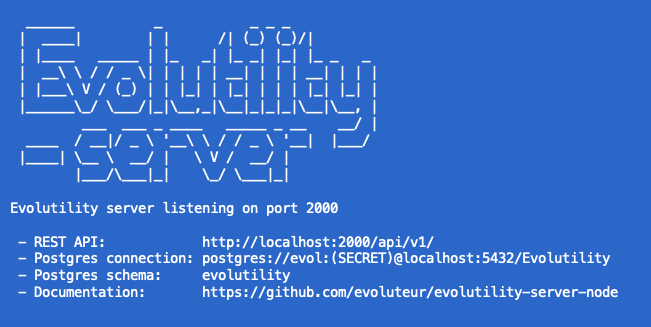
- REST API: http://localhost:2000/api/v1/
- API Docs: http://localhost:2000/api-docs.html
Configuration options are set in the file config.ts.
| Option | Description |
|---|---|
| apiPath | Path for REST API (i.e.: "/api/v1/"). |
| apiPort | Port for REST API (i.e.: 2000). |
| connectionString | DB connection string (i.e.: "postgres://evol:love@localhost:5432/evol"). |
| schema | DB schema name (i.e.: "evolutility"). |
| pageSize | Number of rows per page in pagination (default = 50). |
| maxPageSize | Largest page size a client can request with "pageSize" (default = 1000). |
| lovSize | Maximum number of values allowed for form dropdowns (default = 100). |
| csvSize | Maximum number of rows in CSV export (default = 1000). |
| csvHeader | Use field ids or labels as CSV column headers. |
| uploadPath | Path for pictures and document uploads (i.e.: "../evolutility-ui-react/public/pix/"). |
| uploadMaxSize | Maximum size of uploaded files in bytes (default: 2MB). |
| uploadExtensions | Allowed file extensions for uploads (default: common image and document types, no SVG or HTML). |
| logToConsole | Log SQL and errors to console. |
| logToFile | Log SQL and errors to a file. Log files are named like "evol-2019-09-15.log". |
| wComments | Allow for user comments (not implemented yet). |
| wRating | Allow for user ratings (not implemented yet). |
| wTimestamp | Timestamp columns w/ date of record creation and last update. |
| wWhoIs | "Who-is" columns "created_by" and "updated_by", set to the logged-in user when records are created and updated (values sent by clients are ignored). Reading one record also returns the users' names ("created_by_txt", "updated_by_txt"). The tables need these columns: databases created w/ Evolutility-Models have them; for older tables run ALTER TABLE ... ADD COLUMN created_by integer, ADD COLUMN updated_by integer;, or set wWhoIs: false. Default: true. |
| createdDateColumn | Column containing created date (default "created_at"). |
| updatedDateColumn | Column containing last update date (default "updated_at"). |
| schemaQueries | Enables endpoints to query for lists of tables and columns in the database schema. |
| apiDesigner | Enables editing models through the API (POST, PUT, DELETE on /meta/models). Saving a model can add tables and columns to the database. Default: true. |
| rateLimit | Maximum number of API requests per IP per 15-minute window. Set to 0 to disable. Default: 500. |
| trustProxy | Set to true when running behind a reverse proxy (nginx, Heroku, etc.) so the real client IP is used for rate limiting instead of the proxy's IP. Default: false. |
| corsOrigins | Web sites allowed to call the API from a browser (the url of the UI), with their login cookie. Writes from other sites are refused. Default: ["http://localhost:5173"]. |
| auth.enabled | Require a login. Default: true. |
| auth.anonymousRole | Role of visitors who are not logged in: null (login required) or "viewer" for a public read-only site. Default: null. |
| auth.sessionDays | Number of days before having to log in again. Default: 7. |
| auth.cookieSecure | Send the login cookie over HTTPS only. Default: true when NODE_ENV is "production". |
| auth.cookieSameSite | "Strict" when the UI and the API are on the same site (default), "None" (with HTTPS) when they are on different sites. |
To be accessible by the REST API, each database table must be described in a model. Models contain the name of the driving table and the list of fields/columns present in the API.
Models are stored in the database as JSON (one document per model in the table "evol_model", and every saved version in "evol_model_history"). They are loaded when the server starts, and can be edited through the Models API or in the Designer of Evolutility-UI-React. Changes apply right away, without restarting the server.
The models are written in Evolutility-Models, which generates the SQL to store them in the database.
| Property | Description |
|---|---|
| id | Unique key to identify the entity (used as API parameter). |
| table | Driving database table name (there are secondary tables for fields of type "lov"). |
| pKey | Name of the Primary key column (single column of type serial). Defaults to "id". In the data the key is always called "id". |
| fields | Array of fields. |
| titleField | Field id for the column value used as record title. |
| noCharts | Disable charts and dashboard views. |
| noStats | Disable stats for the object. |
| Property | Description |
|---|---|
| id | Unique key for the field (can be the same as column but doesn't have to be). |
| column | Database column name for the field. |
| lovTable | Table to join to for field value (only for fields of type "lov"). |
| lovColumn | Column name (in the lovTable) for field value (only for fields of type "lov"). |
| lovKey | Primary key column name in the lovTable (default to "id"). |
| lovIcon | Set to true to include an icon with LOV items (only for fields of type "lov"). |
| object | Model id for the object to link to (only for fields of type "lov"). |
| type | Field type is not a database column type but more a UI field type. Possible field types:
|
| required | Determines if the field is required for saving. |
| readOnly | Display field as readOnly (not editable). |
| inMany | Determines if the field is present (by default) in lists of records. |
| inSearch | Determines if the field is used in text searches. |
| max, min | Maximum/Minimum value allowed (only applies to numeric fields). |
| maxLength, minLength | Maximum/Minimum length allowed (only applies to text fields). |
| unique | Values must be unique (not implemented yet). |
| noCharts | Exclude field from charts. |
| noStats | Exclude field from Stats. |
| deleteTrigger | Deleting records in the lovTable will trigger a cascade delete (this property is only used while creating the database). |
Multiple Master-Details can be specified with collections.
| Property | Meaning |
|---|---|
| id | Unique key for the collection. |
| table | DB Table to query (master table, other tables will be included in the query for "lov" fields). |
| column | Column in the detail table to match against id of object. |
| object | Model id for the object to display (optional). |
| orderBy | Column(s) to sort by, e.g. "name" or "drink_date". |
| fields | Array of fields (objects or ids). Fields in collections can be field objects or just ids of fields in the collection's object. |
Example of collection in Wine cellar.
Below is the model for a To-Do app (properties used by the server only, the model also has properties for the UI).
{
  "id": "todo",
  "table": "task",
  "titleField": "title",
  "searchFields": ["title", "duedate", "description"],
  "fields": [
    {
      "id": "title",
      "column": "title",
      "type": "text",
      "required": true,
      "inMany": true
    },
    {
      "id": "duedate",
      "column": "duedate",
      "type": "date",
      "inMany": true
    },
    {
      "id": "category",
      "column": "category_id",
      "type": "lov",
      "lovTable": "task_category",
      "inMany": true
    },
    {
      "id": "priority",
      "column": "priority_id",
      "type": "lov",
      "lovTable": "task_priority",
      "required": true,
      "inMany": true
    },
    {
      "id": "complete",
      "column": "complete",
      "type": "boolean",
      "inMany": true
    },
    {
      "id": "description",
      "column": "description",
      "type": "textmultiline"
    }
  ]
}
More sample models: Address book, Restaurants list, Wine cellar, Graphic novels inventory.
More information about Evolutility models and some useful scripts are available in a separate repository at evolutility-models.
Evolutility-Server-Node provides a generic RESTful API for CRUD (Create, Read, Update, Delete) and more. It is inspired by PostgREST.
When running Evolutility-Server-Node locally, the base url is http://localhost:2000/api/v1/.
Gets a specific record by ID.
GET /{model.id}/{id}

GET /todo/12
By default this endpoint returns nested collections with the record. To reduce response size, collections can be omitted by using the parameter "shallow".
GET /{model.id}/{id}?shallow=1

GET /todo/12?shallow=1
Gets a list of records.
GET /{model.id}

GET /todo
You can filter result rows by adding conditions on fields; each condition is a query string parameter.
GET /{model.id}?{field.id}={operator}.{value}

GET /todo?title=sw.a
GET /todo?priority=in.1,2,3
Adding multiple parameters conjoins the conditions:
GET /todo?complete=0&duedate=lt.2018-12-24
For each field a sub-set of the operators below will be supported by the API (depending on field types).
| Operator | Meaning | Example |
|---|---|---|
| eq | equals | /todo?category=eq.1 |
| gt | greater than | /todo?duedate=gt.2026-01-15 |
| lt | less than | /todo?duedate=lt.2026-01-15 |
| gte | greater than or equal | /todo?duedate=gte.2026-01-15 |
| lte | less than or equal | /todo?duedate=lte.2026-01-15 |
| ct | contains | /todo?title=ct.e |
| sw | starts with | /todo?title=sw.a |
| fw | ends with | /todo?title=fw.z |
| in | one of a list of values | /todo?priority=in.1,2,3 |
| 0 | is false or null | /todo?complete=0 |
| 1 | is true | /todo?complete=1 |
| null | is null | /todo?category=null |
| nn | is not null | /todo?category=nn |
You can search for a specific string across multiple fields at once with the "search" parameter. The list of fields to be searched is specified with "searchFields" in the model (if unspecified, text fields flagged with "inMany" for list view will be used).
GET /{model.id}?search={value}

GET /todo?search=translation
The reserved word "order" reorders the response rows. It uses a comma-separated list of fields and directions:
GET /{model.id}?order={field.id}.{asc/desc}

GET /todo?order=priority.desc,title.asc
If no direction is specified, it defaults to ascending order:
GET /todo?order=duedate
The reserved words "page" and "pageSize" limit the response rows. "pageSize" is capped at maxPageSize in config.ts.
GET /{model.id}?page={pageindex}&pageSize={pagesize}

GET /todo?page=0&pageSize=50
By default all APIs return data in JSON format. Add format=csv to export data as CSV (Excel-compatible).
GET /{model.id}?format=csv

GET /todo?format=csv
Note: Each returned object includes a _full_count property indicating the total number of matching records (before pagination).
To create a row in a database table post a JSON object whose keys are the names of the columns you would like to create. Missing keys will be set to default values when applicable.
POST {model.id} {data}

POST /todo
{ title: 'Finish testing', priority: 2}
Even though it is a POST, the request also returns the newly created record, saving a round-trip.
PATCH or PUT can be used to update specific records.
PATCH /{model.id}/{id} {data}

PATCH /todo/5
{ title: 'Finish testing', priority: 2}
PUT /{model.id}/{id} {data}

PUT /todo/5
{ title: 'Finish testing', priority: 2}
Note: The request returns the updated record, saving a round-trip.
Simply use the DELETE verb with the id of the record to remove.
DELETE /{model.id}/{id}

DELETE /todo/5
To delete multiple records at once, pass multiple ids (separated by commas).
DELETE /{model.id}/{id1},{id2},{id3}

DELETE /todo/5,7,12
In addition to CRUD, Evolutility-Server-Node provides endpoints for charts, lists of values, file upload, and API discovery.
Returns the list of all active objects with URLs to their REST endpoints.
GET /
It is also possible to get a more detailed list of REST endpoints for a specific model.
GET /?id={model.id}

GET /?id=todo
GET /?id=contact
Note: These endpoints must be enabled in the configuration with { apiInfo: true }.
Returns aggregated data for fields of type lov, boolean, integer, decimal, and money. Use noCharts: true on a field to exclude it from charts.
GET /{model.id}/chart/{field.id}

GET /todo/chart/category
Returns the total count, and one object per field with the number of nulls (or empty strings), plus the min, max, average, variance, standard deviation and total for numeric fields, or the min and max length for string fields.
GET /{model.id}/stats

GET /todo/stats
{
  "count": 42,
  "title": { "nulls": 3, "minLength": 4, "maxLength": 52 },
  "price": { "nulls": 5, "min": 1, "max": 99, "avg": 20.5, "sum": 861, "stddev": 12.3, "variance": 151.3 },
  "category": { "nulls": 0 }
}Dropdown fields in the UI (field.type="lov" in the model) have a REST endpoint to get the list of values. This endpoint can also take a search query parameter.
GET /{model.id}/lov/{field.id}

GET /todo/lov/category
GET /todo/lov/category?search=pro
Uploads a file to the server filesystem, in a subfolder named after the model id inside the directory specified by uploadPath in config.ts.
POST /{model.id}/upload/{id}

POST /comics/upload/5
With query parameters: file and "field.id".
File names are sanitized (no directories or special characters) and never overwrite an existing file (a random suffix is added). Errors: 404 unknown model, 400 no file, 413 file too large, 415 file type not allowed.
If the model has collections defined, they can be queried with this endpoint.
GET /{model.id}/collec/{collection.id}?id={id}

GET /winecellar/collec/wine_tasting?id=1
Models are stored in the database as JSON (table "evol_model"). Each model has a version number (_version), and every saved version is kept (table "evol_model_history").
Get all models (with their _version).
GET /meta/models
Get one model.
GET /meta/models/{modelid}

GET /meta/models/todo
Get the JSON Schema of the metamodel (the properties a model can have, with their descriptions). The Designer of Evolutility-UI-React uses it to check models while they are edited.
GET /meta/schema
Get the saved versions of a model, or one of them.
GET /meta/models/{modelid}/history

GET /meta/models/{modelid}/history/{version}
Create a model (POST the model as JSON).
POST /meta/models
Update a model (PUT the model as JSON, with the _version it was read with). If someone else saved the model in between, the update is refused with a 409 error.
PUT /meta/models/{modelid}
Delete a model. Its table and data are kept in the database. Models used by other models (in lov fields or collections) can't be deleted.
DELETE /meta/models/{modelid}
Add ?dryRun=true to POST or PUT to only check the model and list the changes to the database, without saving.
Models are validated before they are saved (names of tables and columns, field types, references to other models...). Invalid models are refused with a 400 error and the list of invalid properties:
{
  "error": "Invalid model",
  "invalids": [{ "id": "fields[2].column", "value": "my col", "condition": "letters, digits and _ only (not starting w/ a digit)" }]
}
Saving a model also updates the database (in the same transaction):
- a new model creates its table (and the tables for its lists of values),
- a new field adds a column,
- nothing is ever dropped: removed fields keep their columns and data,
- changing the type of a column or the table of a model is refused.
The answer to POST and PUT has the saved model, the SQL run, and warnings:
{
  "model": { "id": "todo", "_version": 3, "...": "..." },
  "sql": ["ALTER TABLE \"evolutility\".\"task\" ADD COLUMN IF NOT EXISTS \"tag\" text;"],
  "warnings": [],
  "dryRun": false
}
Note: POST, PUT, and DELETE must be enabled in the configuration with { apiDesigner: true }, and need the admin role (see Users and Login).
These endpoints query the database structure (rather than the data) and return lists of tables and columns.
List of schema tables (props: table, type, readOnly).
GET /db/tables
List of columns (props: column, type, required) for a specified table.
GET /db/{table_name}/columns

GET /db/contact/columns
GET /db/task/columns
Note: These endpoints must be enabled in the configuration with { schemaQueries: true }.
Returns the API version from package.json.
GET /version
Users have a role:
| Role | Can |
|---|---|
| viewer | Read records, models, charts, and stats. |
| editor | Viewer, plus create, update, delete, and upload records. |
| admin | Editor, plus edit models (Designer) and query the database structure. |
Users and sessions are stored in the tables "evol_user" and "evol_session" (created by the SQL script 005_create_users from Evolutility-Models). Passwords are stored as scrypt hashes.
Create a user, or set a new password (and role) for an existing one:
# Password generated and shown once
npm run user:add -- you@example.com admin --name="Your Name"

# Password given
npm run user:add -- someone@example.com viewer --password=a-long-password
Setting a new password ends the sessions of the user.
Log in (the answer sets the session cookie, "httpOnly" so scripts can't read it):
POST /auth/login
{ "email": "you@example.com", "password": "..." }
Log out, or get the current user and role:
POST /auth/logout
GET /auth/me
Manage users (admin role). A password is generated (and returned once) when none is given. Admins can't delete or deactivate themselves, or remove their own admin role. A new password, or deactivating a user, ends the user's sessions.
GET    /auth/users
POST   /auth/users       { "email", "name", "role", "password" (optional) }
PATCH  /auth/users/{id}  { "name", "role", "active", "password", "resetPassword": true }
DELETE /auth/users/{id}
Requests without the role needed are refused with a 401 error (not logged in) or 403 (logged in, but role too low). After 10 failed logins in 15 minutes, logins from that IP address are refused for a while.
To disable login (all requests are allowed), set { auth: { enabled: false } } in the configuration.
Evolutility-Server-Node automatically generates an OpenAPI 3.1 specification from the loaded models — no manual authoring required. Every field type, required constraint, and endpoint is derived directly from the model definitions.
Returns the full OpenAPI 3.1 spec as JSON, reflecting all currently active models.
GET /api/v1/openapi.json
An interactive API explorer is served as a static page at: http://localhost:2000/api-docs.html
It loads Swagger UI and points it at /api/v1/openapi.json. Every model gets its own tag grouping CRUD, stats, charts, list-of-values, and sub-collection endpoints. The spec and the UI stay in sync with the models automatically — adding or modifying a model is immediately reflected.


The spec can also be imported directly into Postman, Insomnia, or any OpenAPI-compatible client or code generator.
All API endpoints are rate-limited per IP address to protect the server and database from abuse. The default is 500 requests per 15-minute window, configurable via rateLimit in config.js. Set it to 0 to disable rate limiting entirely.
When the limit is exceeded the API returns 429 Too Many Requests with a RateLimit header indicating when the window resets.
If the server runs behind a reverse proxy (nginx, Apache, a load balancer, Heroku, Render, Railway, etc.), Express sees the proxy's IP address instead of the real client IP. Without correction, the rate limiter would count all users as one and block everyone simultaneously.
To fix this, set trustProxy: true in config.js. This tells Express to read the real client IP from the X-Forwarded-For header that the proxy injects:
// config.js
rateLimit: 500,
trustProxy: true,   // enable when behind nginx, Heroku, etc.
Only enable trustProxy if you actually control the proxy and trust it to set X-Forwarded-For correctly — enabling it on a directly internet-facing server would allow clients to spoof their IP and bypass the limiter.
Evolutility-Server-Node is released under the AGPLv3 license.
Encourage this project by becoming a sponsor.
Copyright (c) 2026 Olivier Giulieri.