
For AI agents → AGENTS.md
A governed runtime for building agents, connecting operational systems, and turning every action into durable, explainable knowledge. The ecosystem develops itself inside Medulla as changesets, a code graph, and requirement records.


Live architecture and spec status · Repositories and skills · Contribution guide
Spec delivery: Medulla · Scion SDK · Meristem · arbora · Overstory · Tuig · Axil
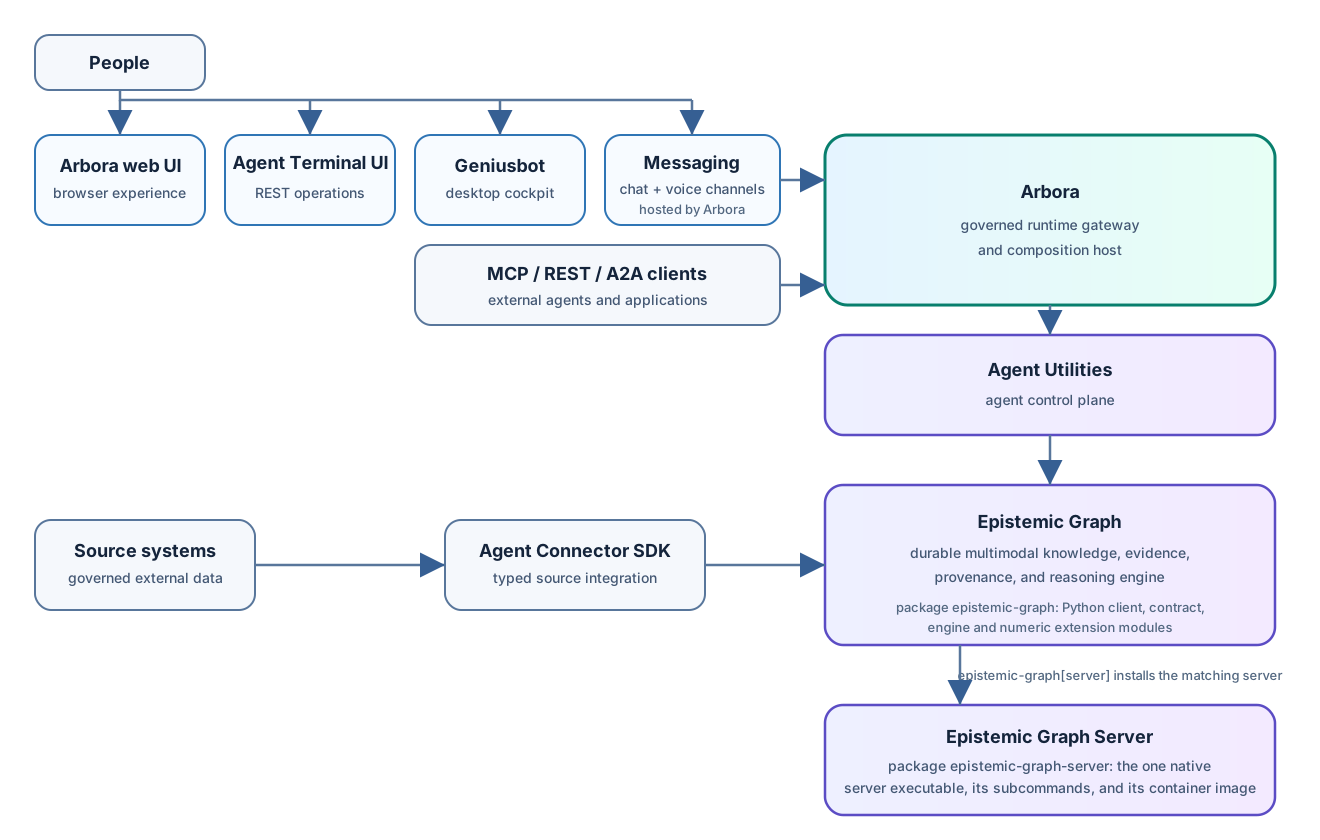
The seven core projects are Arbora, Overstory, Medulla, Meristem, Scion SDK, Tuig, and Axil. Tuig and Axil are further operator surfaces on the same Arbora boundary. Overstory provides the browser operator surface through Arbora. MCP, REST, and A2A clients use the same governed Arbora boundary. Arbora composes the runtime and serves every operation. Meristem is the in-run harness. It applies decisions it receives and holds no store. Medulla commits durable knowledge, evidence, provenance, and reasoning results. Source systems connect through the governed Scion SDK contract.
|
The one door to the platform (formerly graph-os): served operations, admission, authentication, MCP and A2A serving, the registry, and Overstory hosting. |
The browser operator experience (formerly agent-webui) for conversations, approvals, tool activity, and graph-backed work. |
|
The reasoning and durable knowledge engine (formerly epistemic-graph) for graph, RDF, SQL, vectors, time, blobs, evidence, and provenance. Writes use concurrent writers with version checks, mandatory provenance, and contradiction records. Memory decays and consolidates natively. Ships as one engine with one server executable ( |
The in-run agent harness (formerly agent-utilities): run loop, context, fan-out, sandbox, replay, and trace events. It holds no store and serves no API. |
|
The connector contracts and transports (formerly agent-connector-sdk) for connector identity, discovery, synchronization, replay, and write-back. |
The terminal operator surface for the Arbora REST interface. |
|
The desktop GUI for specialist agents, embedded terminals, tool approvals, and graph-backed exploration. |
Arbora is the governed runtime entry point. With Python 3.12+ and uv installed, launch the zero-infrastructure local profile:
uvx --from arbora setup-config generate --profile tiny
uvx --from arbora arbora --transport stdio
The generated profile starts with local, bounded defaults. Continue with the Arbora quick start for provider configuration, Overstory hosting, messaging, and authenticated network transports.
| If you want to… | Start here |
|---|---|
| Run the platform or connect an MCP/A2A client | Arbora documentation |
| Use the browser experience | Overstory documentation |
| Run or extend the agent harness | Meristem documentation |
| Query or operate the knowledge engine directly | Medulla documentation |
| Build or certify a source connector | Scion SDK documentation |
Every repository documents its own contract and links back to this same runtime map. The boundaries are deliberate: Arbora is the door, Meristem runs agents in-run, Medulla owns durable knowledge and reasoning, Overstory presents the browser surface, and Scion SDK governs source integration.
Build and release evidence lives with the component that owns it. Use each repository's Actions page for current CI and its Pages Status or Capabilities section for shipped behavior. Public issues and pull requests are tracked in the owning repository so operational and design discussions retain their architectural context.
The Arbora Architecture Explorer shows every spec row of the core repositories, the connectors and the desktop client with its status, placed on the part of the architecture it builds, and is rebuilt on every merge to a core repository's main branch, and at least every 30 minutes. SPECIFIED rows are open work waiting to be built; delivery and acceptance are separate states. The contribution guide links the shared arbora-development and spec skills.
Concept-proof phases P1 to P5 shipped as release bundles. The architecture explorer shows the releases. Rust serde types are the source of truth for the Medulla wire format. Clients are hand-written and tested on round-trip vectors, and the repositories commit no generated API contracts. Spec status is computed at read time. Spec IDs use the prefixes MEDULLA-, ARBORA-, MERISTEM-, SCION-, OVERSTORY-, TUIG-, AXIL-, CONN--, and PIPE-.
The path is spec-driven, from constitution to release. Each step names its skill and the files it writes:
- Constitution. Read the constitution. Every plan checks against it.
- Route. Pick the owner repository with the ecosystem boundaries and
arbora-development. Choose an open (SPECIFIED) row in Canopy. - Specify.
speckit-specifyandspeckit-clarifywritespecs/<id>/spec.md: user stories, Given/When/Then scenarios, andFR-andSC-labels mapped to row IDs. - Clarify. Resolve every
[NEEDS CLARIFICATION]marker inspec.mdbefore you plan. - Plan.
speckit-planwritesplan.md. Addcontracts/for cross-repository seams,data-model.md,quickstart.md, andresearch.mdwhen unknowns remain. - Tasks.
speckit-taskswritestasks.md. Each line reads- [ ] T001 [P] [US1] <ROW-ID>. - Analyze and checklist.
speckit-analyzechecks consistency and writeschecklists/requirements.md. - Implement.
sdd-implementerbuilds each task. Run the repository gates. - Land. Open a pull request whose commits carry a
Spec: <ROW-ID>trailer and a bound test. Do not editstatus.jsonby hand. - Release. Landed rows ship in the next release bundle.
Standards: constitution, spec standard, spec templates, and Canopy. Install the skills with pip install universal-skills, then install-skills --all-detected --symlink. The step-by-step guide covers local setup, reuse, tests, and pull requests.
All seven core projects are released under the MIT License.
